Epicurius
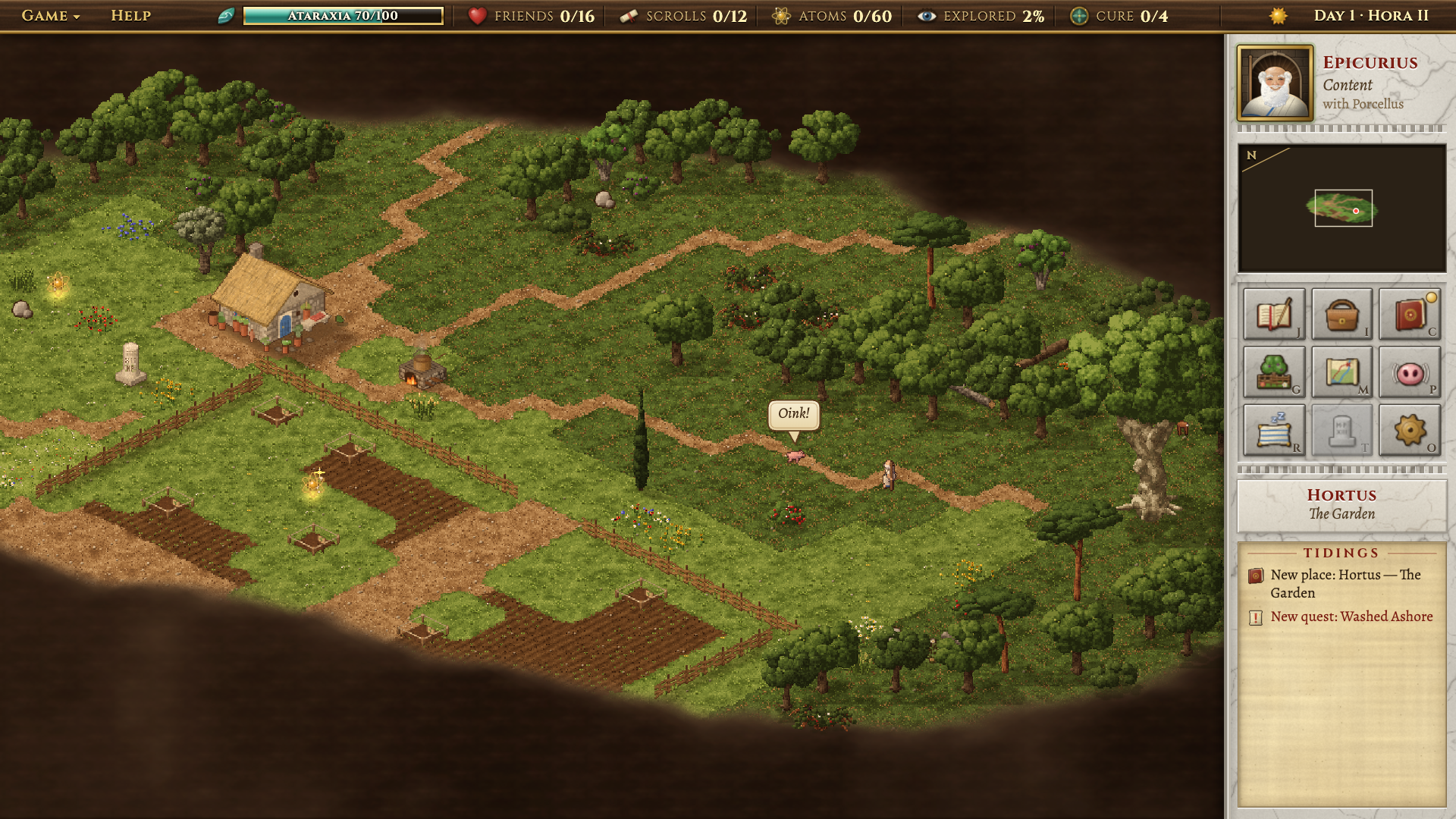
Latium, 54 BC. A merchant ship out of Athens breaks up on the rocks, and the library of Epicurus's Garden goes into the sea. One small, round philosopher washes ashore with a satchel, a sealed letter, a single obol and, somehow, a pig.
The books are scattered, not gone. There are twelve scrolls to find, four fears to cure and a Garden to plant. There are worse ways to spend a life.
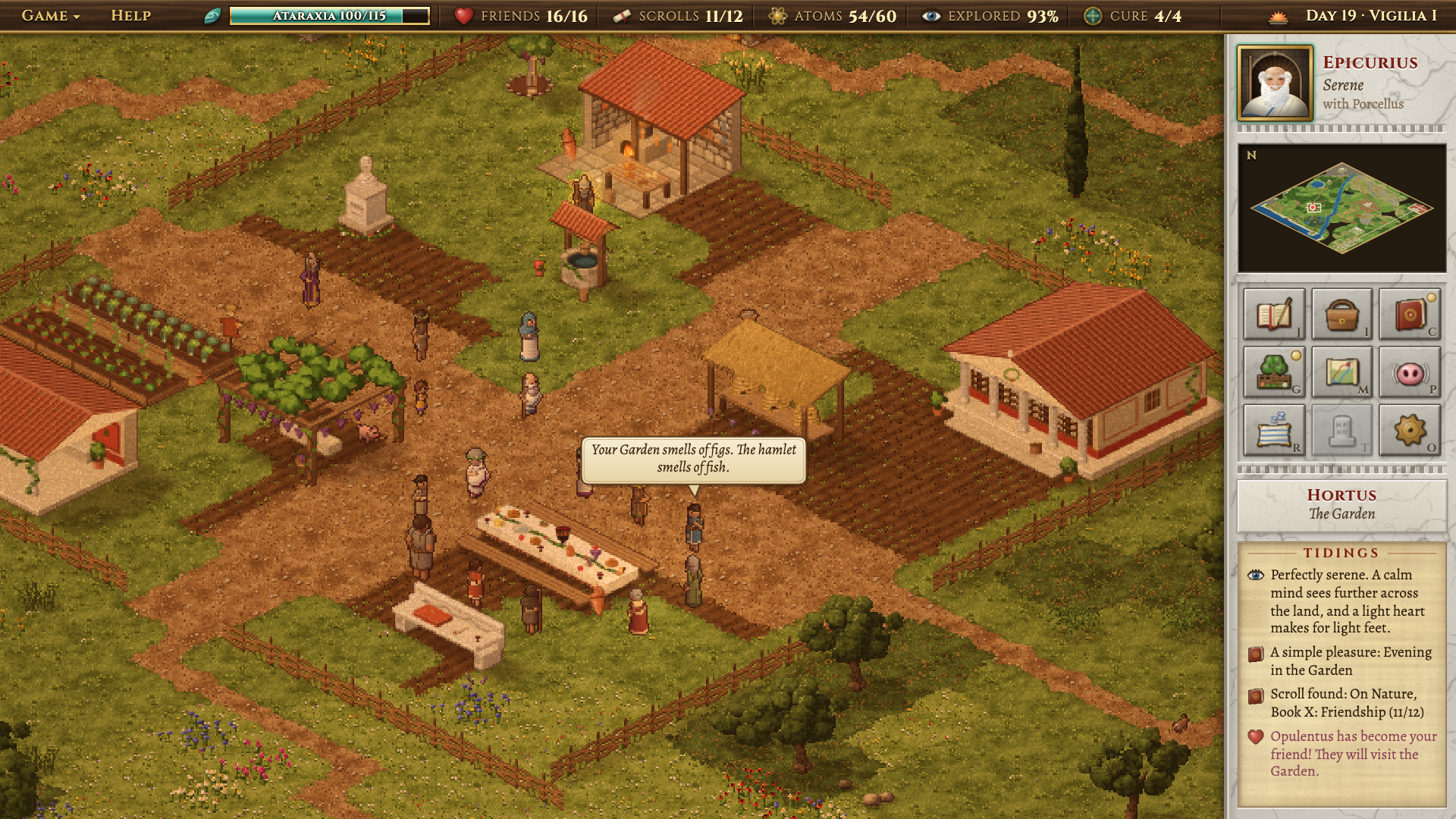
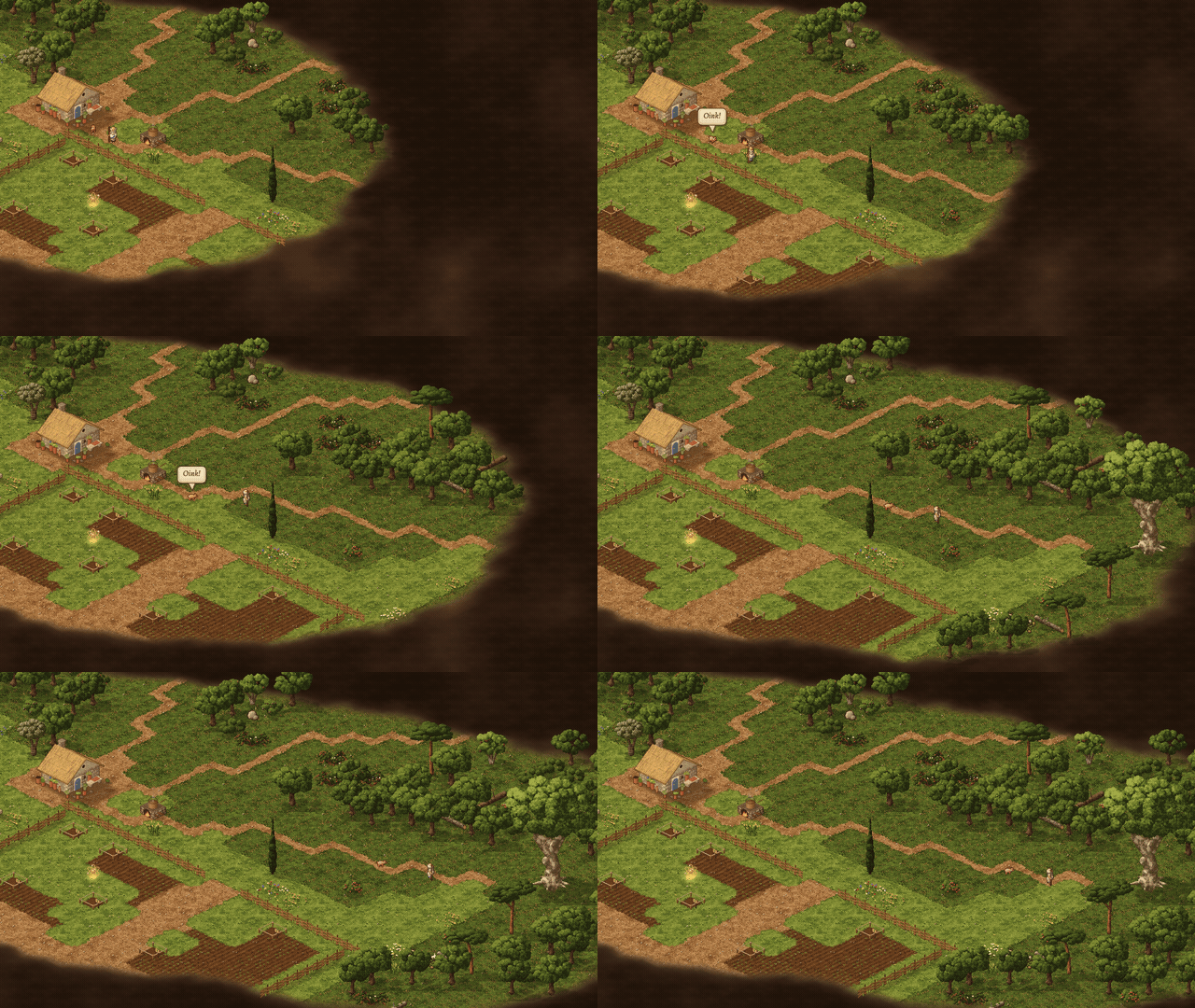
Epicurius is a gentle, funny exploration game in the painted isometric style of the classic Roman city-builders. There is no combat and no way to die. You wander and talk. You eat figs. You win arguments with a well-chosen maxim. And little by little you fill a garden with friends.
What awaits in Latium
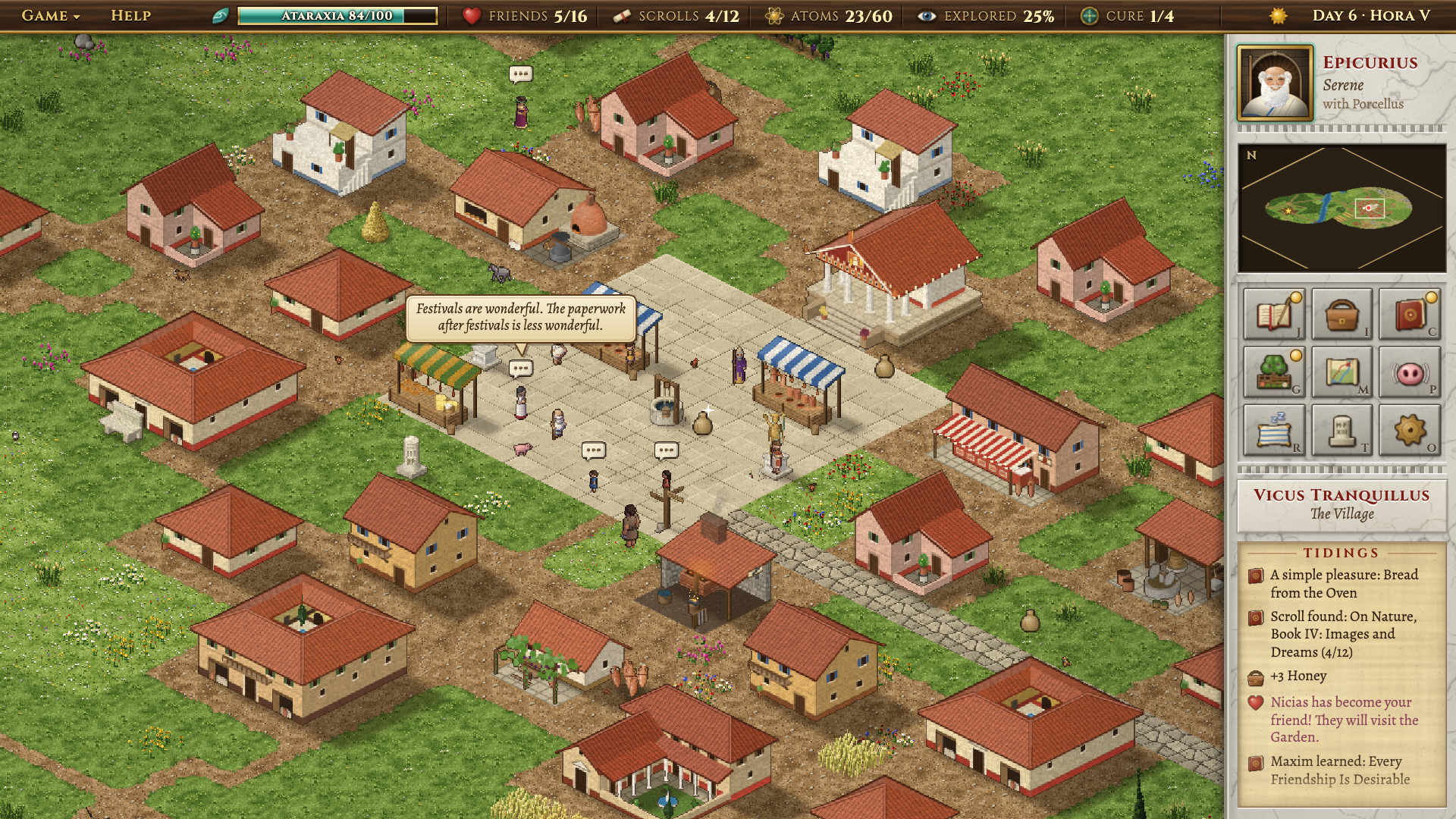
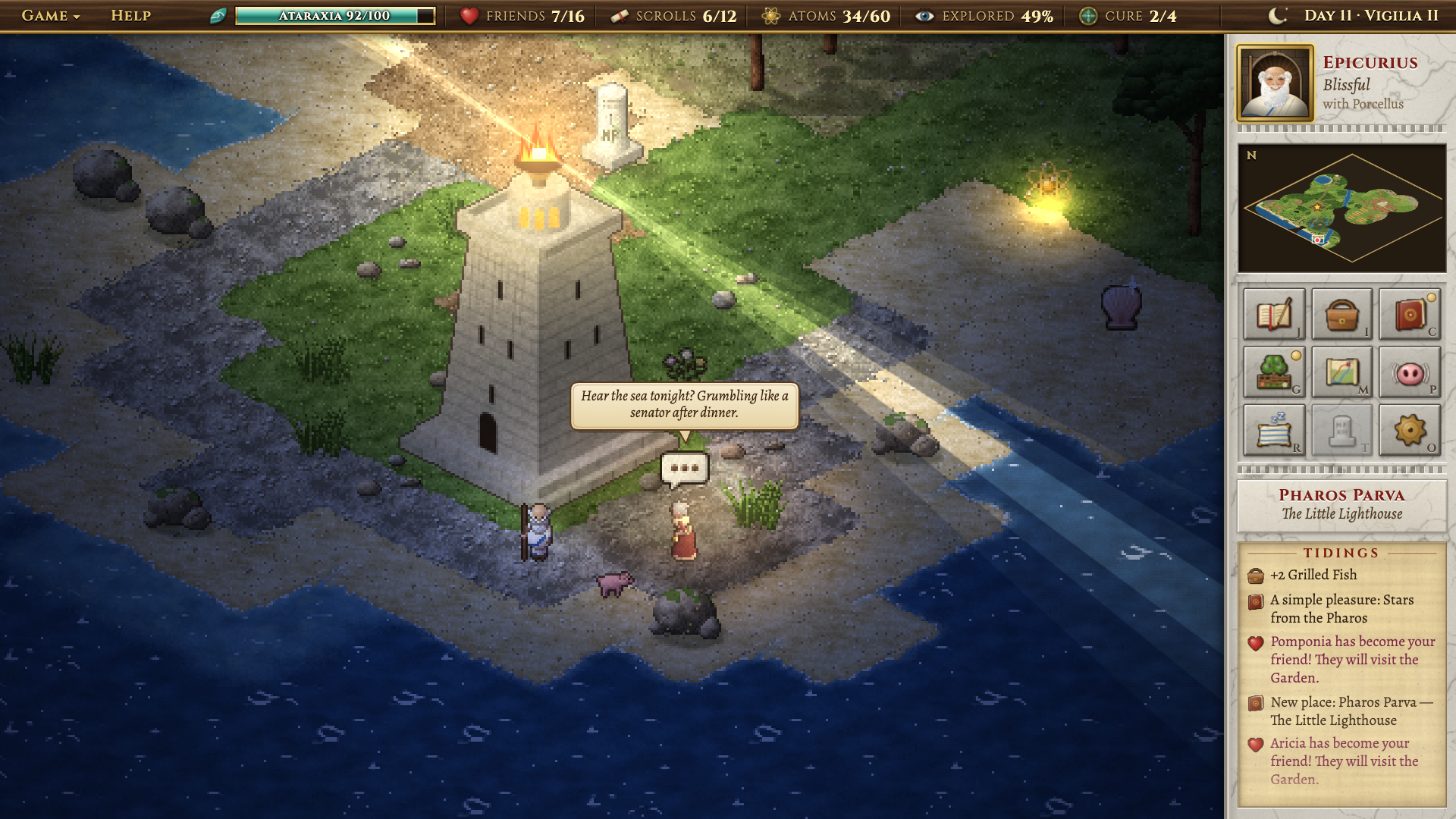
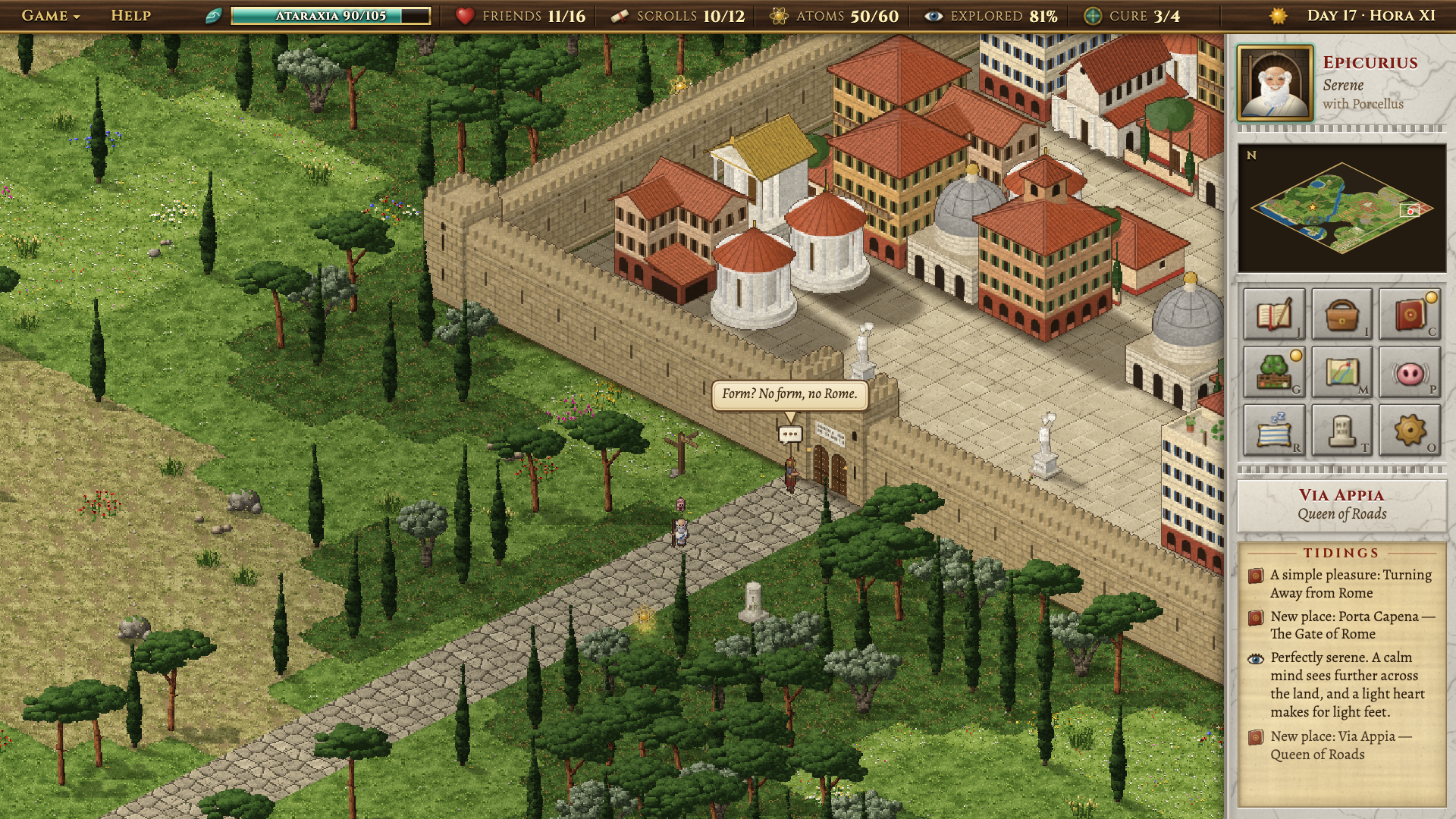
- 19 regions under a fog of war that lifts wherever you walk. They are your Garden, the Whispering Woods, Diana's sacred grove and her lake, the Alban Mount, the high pastures, the Shipwreck Coast, a fishers' hamlet, the marshes, a little lighthouse, a crossroads, a village and its fields, a quarry, an aqueduct, the Via Appia, a rich man's villa, a roadside necropolis and the walls of Rome.
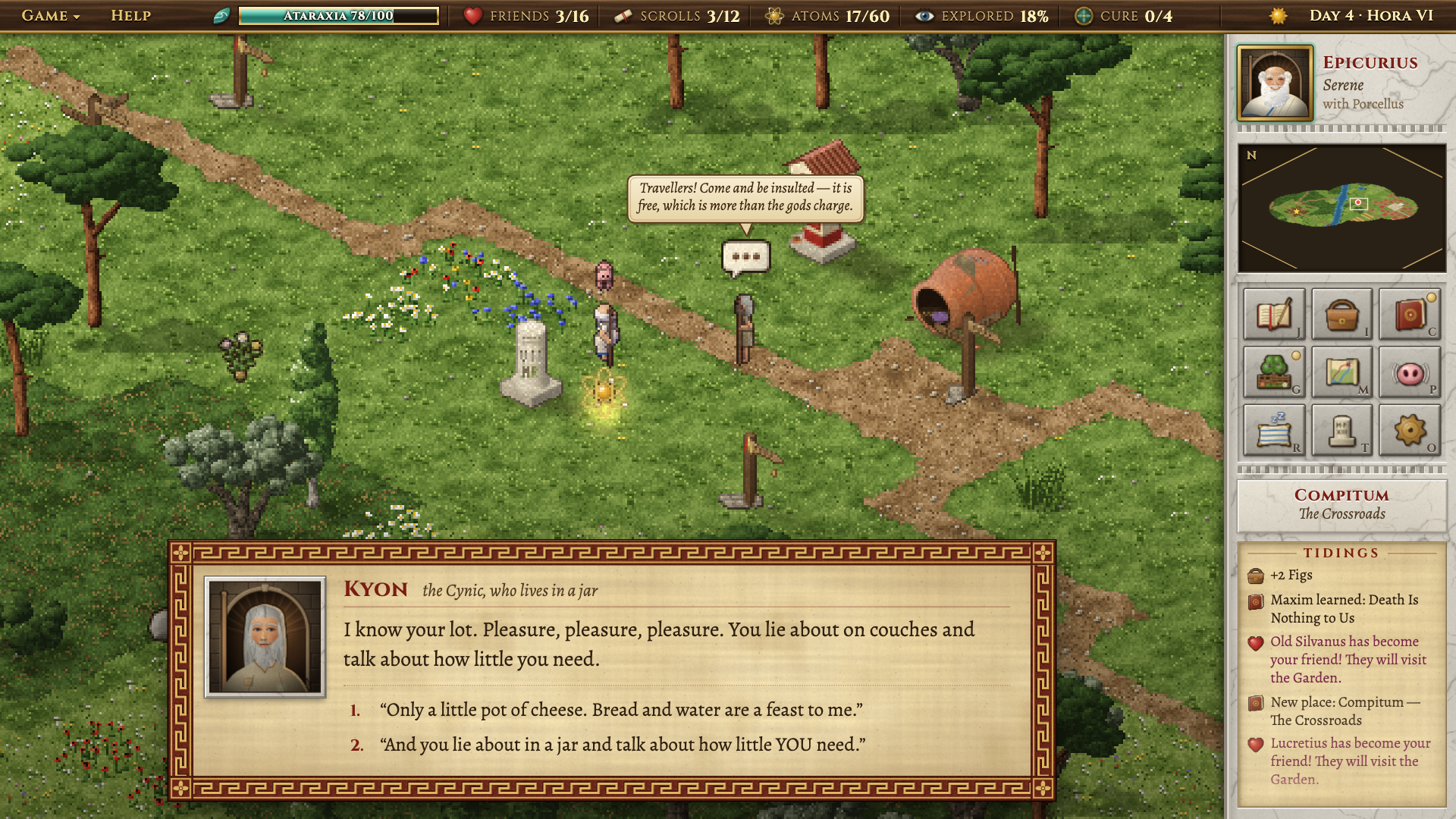
- 37 characters to talk to: 35 people, a pig and a lamb. Among them are a Cynic who lives in a jar, a ferryman who is not dead, thank you very much, a King of the Wood who hasn't slept in seven years, a gentle ex-gladiator, and the poet Lucretius. 16 of them can become your friends.
- 36 quests. There's the main story, 26 side quests, and the Four-Part Cure: four troubled souls, each held by one of the four old fears (the gods, death, want and pain).
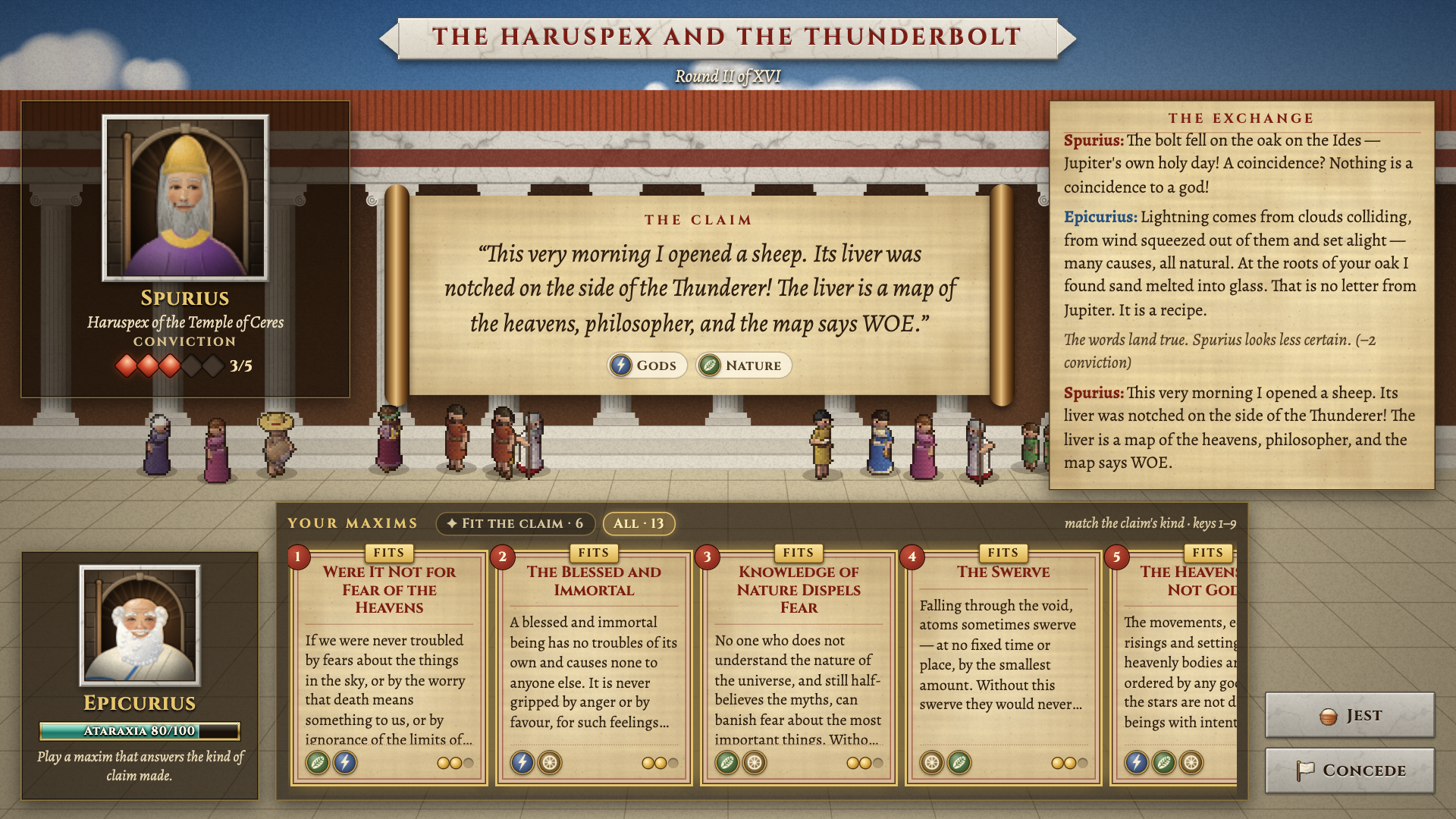
- Debates played with maxims as cards. Your opponent makes a claim about the gods, death, pain, desire, fortune, duty or nature, and you answer with a maxim that fits. There are 7 debates against 5 opponents. One of them is a Stoic "of great height and greater seriousness" who calls Epicureans pleasure-seeking swine. (Porcellus took this personally.)
- Build the Garden. There are 11 structures, from a stone bench and a well to beehives, a vine pergola, a little library, a bust of Epicurus and, at last, the feasting table. Then keep the Feast of the Twentieth.
- Things to collect:
- 30 maxims
- 12 lost scrolls
- 33 simple pleasures, such as a nap beneath a plane tree, rain on the thatch or skipping stones
- 16 herbs
- 22 creatures for your bestiary
- 60 golden atoms for Lucretius. Some of them stay hidden until Porcellus sniffs them out.
- Cook 7 dishes at a hearth or in your garden kitchen, from honey cake and moretum to the perfect simple meal.
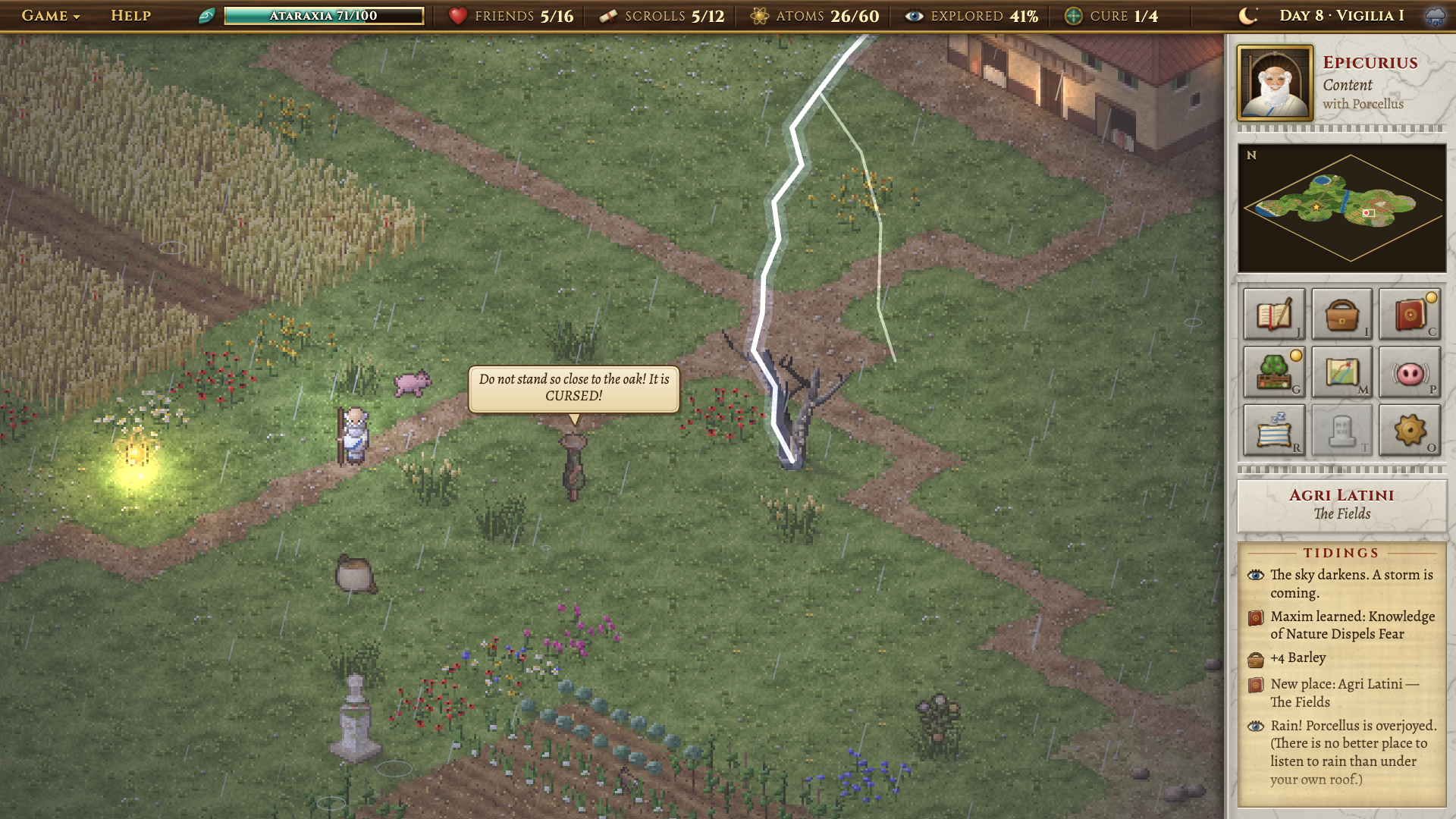
- Day and night. A day lasts 12 minutes. Rain rolls in from the sea, and there is one thunderstorm well worth waiting for. At night, once you've earned a lantern, you walk by its light among owls, fireflies and a nightingale.
- 13 milestones stand along the roads. Find them and travel between them.
- Ataraxia instead of hit points. It is your tranquillity. Food, rest, simple pleasures and good company keep it up.
- The world stays open after the story ends, so you can keep wandering.
Controls
- Click (or tap): walk, talk to people, use things and pick things up. Hold the button to keep walking toward the cursor.
- Right-click: stop walking, or close a window.
- W A S D or the arrow keys: walk.
- E or Space: talk to or use whatever is nearest.
- P: Porcellus sniffs for hidden things.
- Mouse wheel: zoom. There are five levels, also available in Options.
- Windows and actions:
- J Journal
- I Satchel
- C Codex
- G Garden
- M Map
- R Rest
- T Travel (from a milestone)
- O Options
- H Help
- 1–9 and 0: choose a reply in conversation (0 is the tenth). In a debate, 1–9 play a maxim.
- ↑ ↓ Enter: pick a reply.
- Esc: close a window. In conversation, it skips ahead to the next choice.
- F5 / F9: quick save and quick load. It asks before loading.
Every command also has an on-screen button, so you can play with a mouse alone, or by touch in landscape.
Tips
- Stuck? Talk to Porcellus. He gives hints, and jokes. Your journal (J) always says what to do next.
- Sniff often. Press P in new places. 12 of the 60 atoms are hidden, and so are a few other treasures.
- Mind your calm. When ataraxia runs low, eat something, rest at your hut or a garden bench, or visit friends in the Garden. If it runs out, Epicurius simply hurries home. He loses six hours and nothing else.
- Use time as a tool. Some things only happen at dawn, at dusk, at night or at low tide. Rest (R) lets the hours pass: two hours at your hut or a bench, or until dawn if it's already night.
- In a debate, cards marked FITS answer the current claim. You can play each maxim once per debate, and a miss costs a little calm. If you lose, you can try again another time.
- Walk up to every milestone you pass. Once you know two, stand by one and press T to travel to the other.
- Some paths need something first: boots, a bridge, a key, a lantern or a strong friend. Keep talking to people.
- Your journey saves itself every minute and after each quest. Press F5 to save by hand. Saves live in this browser, so private windows or clearing site data erase them.
- Click inside the game once (New Journey does it) before using the keyboard; until then your keys scroll this page. Sound starts with that first click too.
- Use the fullscreen button (bottom-right of the game) for the best view.
Accessibility and comfort
- There is no combat, no death and no timer. Every window, conversation and debate pauses the game.
- Text speed can be slow, normal, fast or instant.
- Lightning flashes can be toned down: switching them Off dims the flashes and stops the screen shake. Until you choose, this follows your system's reduced-motion setting.
- Music, effects and ambience have separate volume controls, and there is a mute. All dialogue is on-screen text, so the game plays fine with the sound off.
- There are five zoom levels. You can play with a mouse alone.
- The game is in English only, and keys can't be remapped yet.
About the game
Epicurius is a love letter to the painted, sun-warmed Roman countryside of Caesar III (Impressions Games, 1998). It is also a love letter to Epicurus of Samos (341–270 BC). He taught that pleasure is the absence of pain in the body and of trouble in the soul, and that of all the things wisdom provides for a happy life, friendship is by far the greatest. Lucretius, the King of the Wood and a certain pig have been granted poetic liberties.
Every picture and every sound is made by code, right in your browser. The landscapes, buildings, characters, portraits and icons are painted with Canvas 2D. The music (six moods, composed as you play), fifteen regional soundscapes and every sound effect are synthesised with WebAudio. There is not a single image or audio file in the game. It is plain JavaScript, with no engine, no libraries and no build step: about 46,000 lines in 24 script files, plus one stylesheet and index.html. The whole game is under 3 MB unpacked and under 1 MB zipped.
It loads two web fonts, Cinzel and Alegreya, and falls back to a plain serif if they can't load. Your journey is saved in your browser, so clearing site data, or playing in a private window, will lose it.
Made with Claude Code. Fonts: Cinzel (Natanael Gama) and Alegreya (Huerta Tipográfica), SIL Open Font License, via Google Fonts.
Leave a comment
Log in with itch.io to leave a comment.